
Exploring the Tarpon Springs Heritage Museum: Greek Roots and Florida History by the Bay

Tucked inside the former library at Tarpon Springs’ Craig Park, the Tarpon Springs Heritage Museum tells the story of a city shaped by the sea.
At a Glance
◇ Location: 100 Beekman Lane, Tarpon Springs, FL
◇ Hours: Tuesday–Saturday, 10 AM–4 PM
◇ Admission: $5 adults, kids under 12 free
◇ Time needed: 30–45 minutes
Wander Florida is fully reader-supported. For that reason, this article may contain affiliate links. If you make a purchase through one of the affiliate links, I may earn a small commission at no additional cost to you. This revenue helps keep Wander Florida free and updated. I only recommend products or services that I would use myself. Read the full disclosure here.

About Tarpon Springs Heritage Museum
The Tarpon Springs Heritage Museum sits inside Craig Park, a peaceful waterfront setting overlooking Spring Bayou. If you’ve ever been to Tarpon Springs, you already know the city has layers of culture and history you don’t get in most Florida towns. The museum does a good job laying those layers out in a way that feels manageable—even if you’re not usually a “read every exhibit panel” kind of person.
Run by the City of Tarpon Springs, the Heritage Museum is one of several cultural sites in town, and it focuses specifically on the local history, Greek influence, and sponge diving heritage that shaped the city into what it is today. It’s housed in a historic building originally constructed as a library in 1964. Today it’s a quiet, well-curated space that blends historic artifacts, cultural displays, and local artwork, including an entire gallery dedicated to Florida artist Christopher Still.
This isn’t a huge museum, and that’s part of its charm. You can explore at your own pace, take in the exhibits, and still have time for a walk along the bayou afterward. It’s ideal for anyone who loves Florida’s early history, small museums that pack more meaning than flash, or understanding a place beyond the quick tourist version.
What to Expect During Your Visit
Plan for about 30–45 minutes inside the museum—longer if you enjoy reading interpretive signage or examining artwork closely. The museum is divided into two primary wings: one dedicated to artist Christopher Still, and the other to the history of Tarpon Springs and the Greek sponge diving industry.
The museum opens at 10:00 AM. They let me in a few minutes early; I was loitering around the outside patio reading the signage by the doors. Even during working hours, you have to ring the doorbell to be let in.
You’ll check in at the small welcome desk, where staff are happy to answer questions about the exhibits or the area. When I was finished wandering through the space, I had a question about the sponge diving exhibit, and almost every staff member in the museum went with me to figure out my question (One exhibit says its the rudder and tiller of a sponge boat, but there’s no rudder; just the tiller.) We all learned something new, and they were more than happy to help.
Admission is modest, and it’s one of the most affordable things to do in Tarpon Springs if you’re building a day trip itinerary.
Inside Tarpon Springs Heritage Museum, the layout is simple and easy to navigate:
- The Christopher Still Wing showcases Still’s art, his influences, and his connection to Tarpon Springs.
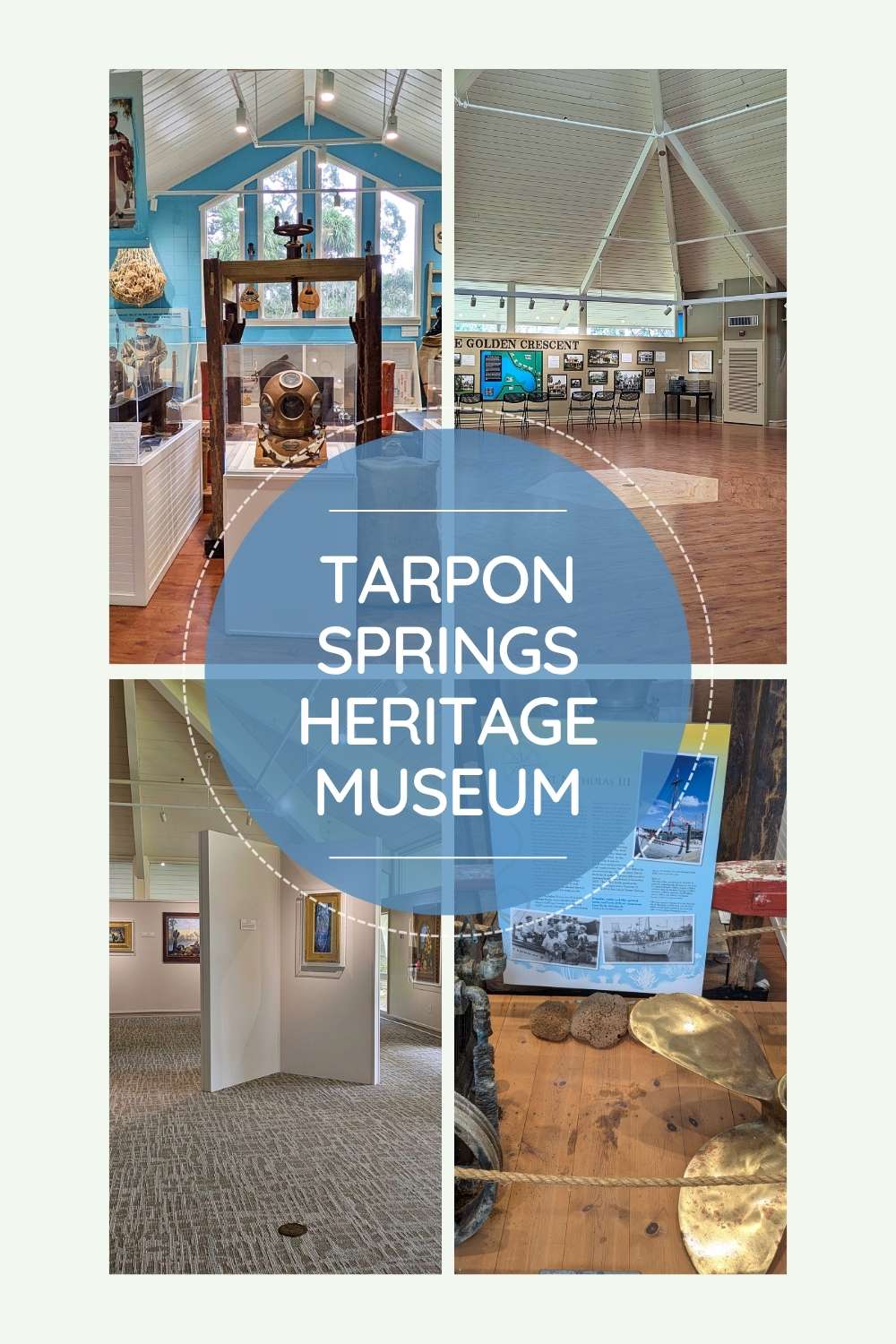
- The History Wing uses artifacts, photographs, and displays to tell the story of the city—from its earliest Native American inhabitants to the arrival of Greek sponge divers in the early 1900s.
- Hands-on elements or interactive components are limited, but the interpretive panels are well-written and informative.
- Atmosphere is quiet and contemplative. This is a museum where you come to learn, reflect, and get a more complete picture of the city—not a place with bells and whistles.
If you visit in the morning, the light that filters in through the windows makes the artwork and exhibits especially pleasant to view. And when you step back outside, you’re right in Craig Park, with its curved shoreline, oak trees, and short walking path around Spring Bayou.
Christopher Still Wing
Artist Christopher Still is a Florida native known for capturing the stories, landscapes, and cultural heritage of the state in ways that feel both intimate and epic. He grew up in the Tampa Bay area, and Tarpon Springs has long been one of his artistic muses, thanks to its Greek community, sponge diving tradition, and distinctive coastal environment.
The museum’s Still Wing showcases reproductions and selected originals of his works, along with displays that explain his artistic process. If you’ve seen his murals in the Florida Capitol or his large-scale paintings in hospitals and public buildings around Tampa Bay, you’ll immediately recognize his style: rich, detailed, and almost cinematic.


The exhibit includes:
- Interpretive panels explaining the symbolism he uses
- Sketches and studies that reveal how his paintings evolve
- Background on his connection to Tarpon Springs, including the Greek families who helped shape his understanding of the city’s heritage
- Notes on the commissioned works he completed for local institutions
It’s a thoughtful space that helps visitors understand not just his art, but the culture that inspires it. Even if you’re not usually drawn to art exhibits, this one is accessible and deeply tied to the community’s story.
History of Tarpon Springs Wing
The second wing focuses on the broader history of Tarpon Springs, which stretches back long before the Greek sponge divers arrived. Humans have lived along these shores for thousands of years, and early archaeological work revealed shell middens and burial mounds within the region—evidence of Indigenous people who thrived on the Gulf Coast’s natural resources.


The museum covers several key periods:
Early Settlement and the Bayou
In the late 1800s, Tarpon Springs began attracting wealthy Northerners who wintered along the shores of Spring Bayou. Development grew around the natural waterways, and the city’s early architecture reflects this era of Florida’s resort-town beginnings.
Railroad Expansion
The arrival of the railroad in the 1880s and 1890s connected Tarpon Springs to the rest of Florida, bringing more settlers and expanding the sponge industry’s reach.
Sponge Industry
This is where the museum’s story starts blending into the next section. Displays highlight early sponge harvesting methods, the business side of the industry, and the boom that made Tarpon Springs the “Sponge Capital of the World.”
Photographs, documents, and artifacts help bring the city’s development to life. It’s a clear, educational overview that gives context to everything else you’ll see around town.
Greek Influence & Sponge Diving Exhibit
If you’ve spent any time in Tarpon Springs, you already know the Greek heritage isn’t just an add-on—it’s the heart of the city.
In the early 1900s, Greek immigrants, many from the Dodecanese islands, brought their deep-water sponge diving techniques to Tarpon Springs. This revolutionized the industry overnight. Instead of hooking sponges from boats, divers suited up in heavy rubber suits, weighted boots, and copper helmets, descending to the sea floor to harvest sponges by hand.


The exhibit here covers:
- Early diving suits and equipment
- Photographs of sponge boats and divers
- The dangers of deep-water diving
- Cultural traditions that took root in Tarpon Springs’ Greek community
- The rise and fall of sponge industry demand over the 20th century
You’ll also see how the community continues to celebrate its Greek roots today—through festivals, shops, restaurants, and the historic Sponge Docks just a short drive away.
This section ties together Tarpon Springs’ identity in a way that’s both factual and deeply human. It was my favorite part of the museum. There’s something deeply connecting in learning more about other cultures and seeing the things that makes us the same as well as unique.
Beyond the Museum: Exploring Craig Park
One of the best parts of visiting the Heritage Museum is stepping outside afterward and realizing you’re already in Craig Park, one of Tarpon Springs’ most scenic public spaces.
Craig Park wraps around Spring Bayou, a calm, horseshoe-shaped inlet framed by large live oaks, historic homes, and water views. If you visit in winter, you may even see manatees gathering in the warmer bayou water.
A few things worth doing after the museum:
- Walk the short loop path around the bayou
- Look for historic markers throughout the park
- Visit the nearby Safford House Museum, another preserved piece of local history (you can get a combo ticket to visit more museums in one day)
- Sit on the benches along the shoreline and enjoy the view
- Spot mullet jumping near the seawall (they always seem to be performing here)
Craig Park is also the home of the city’s famous Epiphany celebration, when Greek Orthodox divers retrieve a cross thrown into the water each January—a tradition that draws crowds from across the country. Visiting the museum helps put that ceremony into context.
Tips for Visiting Tarpon Springs Heritage Museum
A few practical notes to help you plan your visit:
- Hours: Tuesday–Saturday, 10 AM–4 PM.
- Admission: $5 for adults; kids under 12 are usually free.
- Time Needed: 30–45 minutes.
- Location: Inside Craig Park, 100 Beekman Lane.
- Parking: Free.
- Best Time to Visit: Late morning for good lighting and cooler walking weather.
- Accessibility: The museum is on one level with accessible entry.
- Combine Your Visit With: A stroll around Spring Bayou, the Safford House Museum, the Sponge Docks, or the historic downtown district.

Final Thoughts: Tarpon Springs Heritage Museum
The Tarpon Springs Heritage Museum is the kind of place that rewards curiosity. It isn’t large, it isn’t flashy, and it won’t compete with major museums in Tampa or St. Pete, but that’s exactly why it’s worth visiting. It’s quiet, grounded, and full of context you won’t get just by wandering the Sponge Docks or browsing the shops.
If you enjoy understanding a place through its history, and you appreciate museums that focus on real people, real stories, and a strong sense of place, this one belongs on your list. And when you step back outside and see Spring Bayou right there, framed by oak trees and historic homes, the city’s story feels that much more connected.
Let’s Connect!
Follow me on Facebook, YouTube, and Instagram. And if you’re looking for a great community for sharing travel tips, discounts, secret spots, and hidden gems, go join my Facebook group, Florida Travel Tips & Secret Spots.
Travel Resources:
These are the places I first go when planning or booking travel. They ARE affiliate links so if you use one I may earn a small commission (at no cost to you) and (bonus!) it’ll help me keep running this site. Visit my travel resources page to see all of the services and gear I recommend.
Flights: We always check flight prices and information on Way Away first.
Hotels: We use Expedia to compare and book hotels. We also love Booking.com for boutique hotels and B&Bs.
Vacation Rentals: For vacation rentals and other non-traditional lodging options, VRBO is our go-to.
Tours & Tickets: We use Viator for private tours and unique experiences.
Rental Cars: Though we prefer to experience a city through its public transportation, there are times when a rental car is needed and in those instances, we use Discover Cars.
Travel Insurance: No one wants to need it, but it’s great to have when you do. VisitorsCoverage is our go-to provider.


This was a lovely story. I hate to be a stickler but the library was built in 1964 not 1927.
Thank you! I’m not sure where I saw that year. I’m always happy to be corrected!