
The Most Historic Buildings in Tarpon Springs

As I wandered down Dodecanese Boulevard one Friday morning looking at the shops and restaurants in Tarpon Springs, I kept wondering about the architecture of the historic buildings in Tarpon Springs. Granted, Tarpon Springs is a mish-mosh of Florida vernacular, modern ranch, and Greek, for lack of a better term.
Specifically though, I’ve always wondered if the blue and white found on so many commercial buildings is just a “thing” because of the colors on the Greek flag or if it’s truly a Greek style of décor and architecture. Before even getting out of bed the next day, I pulled up an internet search on my phone – the question had been running through my head all night – and took a look.

A quick search pulled up dizzying images of white buildings with gorgeous seas in the background. And a dismally long list of ancient Greek architecture sites. Intrigued by the images more than the websites, I remembered from my research into Tarpon Springs’ history that the original 500 Greek immigrants to the Gulf Coast town had been brought in as sponge divers in 1905, from several Greek islands. These islands today are known collectively as the Cyclades and their unique architecture as Cycladic. Now I was getting somewhere!
Typical of the Cycladic style are white-washed walls, blue doors and windows, and domed roof elements. In the Greek islands, the buildings also have walled courtyards (because there were lots of invasions back in the day – 1000 years ago), are typically one story, and have few windows on the north wall but many on the south and east walls (because there was NOT air conditioning back in the day).
The only thing that truly remains of these architectural details in Tarpon Springs is the color scheme and the occasional dome on a roof.
Wander Florida is fully reader-supported. For that reason, this article may contain affiliate links. If you make a purchase through one of the affiliate links, I may earn a small commission at no additional cost to you. This revenue helps keep Wander Florida free and updated. I only recommend products or services that I would use myself. Read the full disclosure here.
Despite its deep Greek roots and culture, Tarpon Springs was founded a good 50 years before the Greek arrival. And this explains why the predominant architecture of the historic homes in Tarpon Springs is Florida vernacular, sometimes called Florida cracker.
What is Florida Vernacular?
Though the Florida vernacular style looks similar to Victorian, and some of the homes do incorporate the whimsy of the Victorian era, for the most part the decorative woodwork is missing in Florida vernacular. This is a style more suited for function.
The examples around Tarpon Springs lean towards two-story, wood-frame homes with steeply-pitched roofs and wide front porches. Some have a second story balcony as well. The only decorative elements can be found on those upper balconies worked into the iron railings. Otherwise, these homes are simple. They represented safety and protection to their residents, nothing more.

The Florida vernacular homes in Tarpon Springs more often than not evolved from the shotgun, or dogtrot, home, the earliest cabins of those few who settled around Spring Bayou in the 1850s. Over time, the small, single-story cabins would grow into two-story residences of the wealthier townspeople, but they maintained their characteristic layout – rectangular with a central hallway from front door to back door through which you could fire a shotgun without hitting a wall. Or so legend says; I haven’t personally tested this theory.
Where the shotgun style comes from is anyone’s guess. Some say Bahamian spongers introduced the style, but it was used in other parts of the state long before Tarpon Springs existed. The more logical answer is that it came from Africa by way of slaves and was first used in New Orleans. The simple style and ease of construction would have made it popular on plantations. The wealthy settlers who first came to Florida likely adopted the style as a quick and inexpensive way to build their first homes, especially as they had lots of lumber to work with.


So how will you know a Florida vernacular home when you see one? Vernacular simply means that the style is functional and uses readily available materials. In Florida, it is characterized by wood frame, masonry, and less often brick construction (one or two story, rarely three); metal roofs though some have shingles now; raised floors (they were built off the ground, not directly on it); and the shotgun hallway though after several additions and renovations the central hallway might not be central anymore. Or might be missing altogether if a renovation included “opening up” the living space.
They also have steeply-pitched often pyramidal roofs, overhangs with exposed rafter tails, and dormers for attic circulation, and open front porches with shed roofs (in other words, the porch roof is not part of the house roof). Despite their somewhat spartan exterior appearance, these homes served the early Floridians well and continue to do so.


Throughout Florida, the larger vernacular homes and smaller shotgun homes can still be found. Other architecture styles made their way to the state – Greek Revival, Spanish mission, Neo-classical, and Queen Anne – but the Florida vernacular shows how other styles were adopted, and adapted, for life in Florida’s humid, hot, and sometimes harsh, climate.
22 Most Historic Buildings in Tarpon Springs
I expect this list will grow as I photograph and learn the histories of other historic buildings in Tarpon Springs. Though the Florida vernacular architectural style is predominant throughout the state, developers and builders certainly brought in other styles, especially as wealthier citizens made more permanent homes and businesses here.
As you’ll see below, some of Tarpon Springs’ historic buildings are definitely looking at function over beauty, but many buildings were constructed in the styles that were popular at the time they were built, like Queen Anne or Mediterranean revival. It makes for a wonderful hodge podge of beautiful buildings.
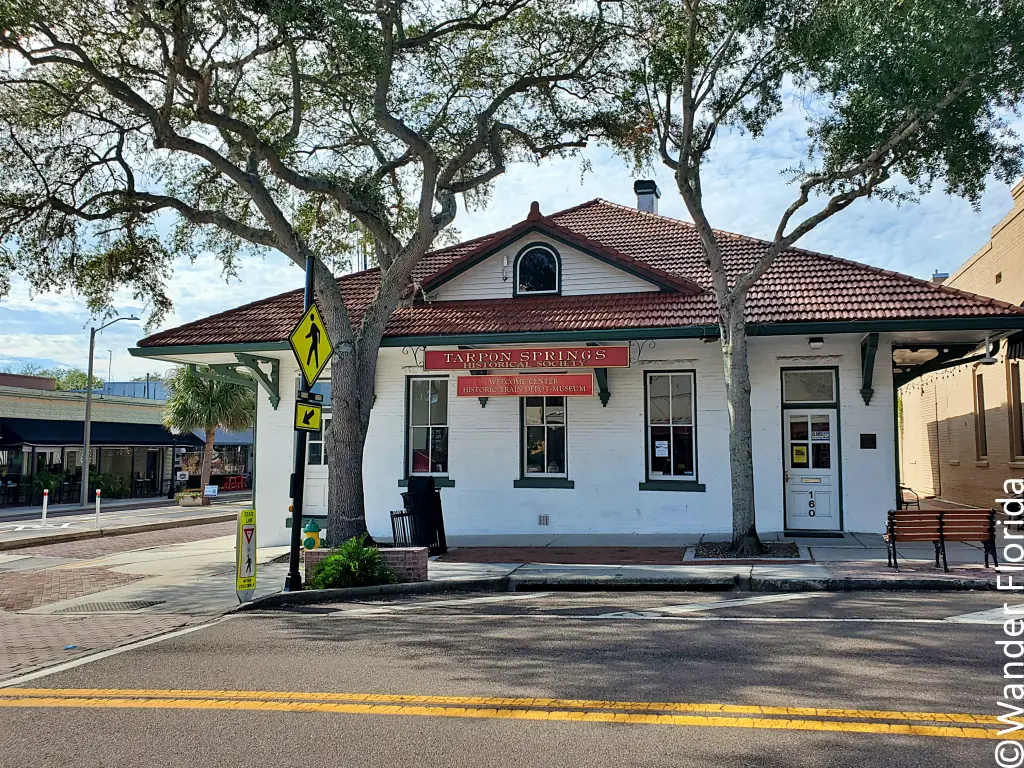

Tarpon Springs Historic Train Depot
The historic train depot in Tarpon Springs, Florida is a significant landmark that holds a special place in the town’s history. Built in 1909, this charming Mediterranean Revival-style building served as a vital transportation hub during the early 20th century. Serving both passengers and goods, it facilitated trade and tourism and contributed to the town’s growth.
Built by the Atlantic Coast Line Railroad, it used lines first put down by the Orange Belt Railway. Prior to the railroad coming to Tarpon Springs, anyone who wanted to come to the town had a long and arduous journey. First, they took a train to Sanford which is northeast of Orlando. From there, they embark on a 130 mile journey by horse drawn carriage or buggy to Cedar Key 70 miles north of Tarpon Springs. From Cedar Key, passengers took a boat those last 70 miles to Tarpon Springs.
With the railroad opened to Tarpon Springs in 1887 and then this new train depot in 1909, the town’s population exploded. Besides good and tourists, the depot played a pivotal role in transporting sponges harvested from the Gulf of Mexico to markets across the country, making Tarpon Springs the “Sponge Capital of the World”.
A striking example of Mediterranean Revival architecture, it features a stucco exterior, red-tiled roof, arched windows, and decorative detailing. Its design captures the elegance of the era in which it was constructed. Over the years, the Tarpon Springs train depot has been lovingly restored and preserved by the community. Its historical significance has been recognized, and it now stands as a symbol of Tarpon Springs’ commitment to honoring its past.
Today, the train depot is home to the Tarpon Springs Historical Society and Tarpon Springs Historical Train Depot Museum. Visitors can explore exhibits, photographs, and artifacts that tell the story of Tarpon Springs’ development and its ties to the railroad. The depot occasionally hosts cultural events, workshops, and exhibits related to the history of Tarpon Springs and its sponge diving heritage.

Railway Express Company Building I
This building might not be on your list of the most historic buildings in Tarpon Springs; however, I put it (and the next building) in this place on the list because of the ties to the railroad.
The historic marker on the building reads: “The Railway Express Company Building, a one-part masonry vernacular commercial structure, was built sometime between 1913 and 1919. It originally housed the offices of the Railway Express Company. At some point, between 1919 and 1926, Railway Express built a new building on the property just north of the site and a laundry was subsequently established. The building was restored between 1985 and 1986.”
A search for Railway Express Company yielded no additional information. However, private parcel delivery by way of railroad was a popular way to send packages in the early part of the 20th century. There were four major companies which handled this service with the US Post Office joining the fray in 1913.
During a severe coal shortage in 1917, President Woodrow Wilson nationalized the railroads to aid in the transportation of soldiers and supplies. The express companies were consolidated into a single company, American Railway Express Agency, which was formed in July 1918 as a consolidation of the four major and three minor express companies. The new company took control of all the pooled equipment and property of existing express companies, the largest share of which came from American Express. Yes, now a credit card company.
American Railway Express Agency became Railway Express Agency in 1929. Tarpon Springs’ Railway Express Company was likely one of the minor express companies mentioned above. Today, the building is home to Tuscan Sun Italian Bistro, a casual eatery which features cuisine from the Mediterranean and across the Americas.

Railway Express Company Building II
If you guessed that this is the building “to the north” to which the Railway Express Company moved, you’d be right. The historical marker reads:
“This one-part vernacular commercial building was built sometime between 1919 and 1926 as the new location of the Railway Express Company.”
Interestingly, the nationalized railroads were returned to private ownership in March 1920 after the end of World War I. When American Railway Express Company became Railway Express Agency in 1929, it was owned by 86 railroads in proportion to the express traffic on their lines; no one railroad or group of railroads controlled the agency.
Today, this building houses Tarpon Tavern, an Old World-style pub which serves burgers and other pub grub alongside craft beers and all of the other pub drink favorites.


Old City Hall
Old City Hall in Tarpon Springs, Florida is a historic building that once served as the municipal government center for the city. It was constructed in 1915 and designed in the Neoclassical architectural style, which was popular during that time. The building features classical elements such as columns, a pediment, and symmetrical design. The one-story part of the building was added in 1947 to accommodate the city’s growing needs.
Tarpon Springs’ Old City Hall served as the city’s primary government building for many years. When it was built, it housed all of the government offices, the public library, and the police station on the first floor. The city commission met on the second floor, and there was also a courtroom.
In 1989 this historic building in Tarpon Springs was renovated and became the Tarpon Springs Cultural Center. Today it is the heart of the Tarpon Springs arts and culture scene. Inside it houses a performing arts center and the Center for Gulf Coast Folklife.

Tarpon Arcade
The Tarpon Arcade opened in 1926 as the Arcade Hotel. Built in a Spanish Renaissance style, the hotel housed a post office, library, restaurant, and stores on the first level with two wings of hotel rooms on the second level. The arched entry seen in the photo was originally a drive-through feature.
After it was known as the Arcade Hotel, it became the Howard Hotel. In the 1930s on the brink of the Great Depression, several people are said to have committed suicide.
In 1976 a fire destroyed the original iconic towers and new façade was constructed without them. The building fell into disrepair into the the 1980s but was placed on the National Register of Historic Places in 1984 and restored in 1985, including replica towers. Today it serves as an office building.


Sponge Exchange
Many people know the Sponge Docks are an important part of Tarpon Springs history. And some might even know the importance of what appears to be an outdoor mall right across the street from the docks. This is the Sponge Exchange, and it’s as much a part of sponging history as the docks.
The historic Sponge Exchange in Tarpon Springs provided a place for the storage and sale of sponges, especially in the heyday of operations in the 1930s. A historic marker on the docks, to the west of the Diver Statue, reads:
The Gulf waters off the west coast of Florida north of Tampa Bay comprise one of the few areas of the world where the species of natural sponges suitable for commercial use are found. The natural sponge industry in Tarpon Springs dates from about 1890 when John K. Cheyney launched his first sponge-fishing boat. Sponges were retrieved by hooking until the technique of diving for sponges was introduced in 1905 by John Cocoris, a recent immigrant from Greece, where the practice of sponge diving was common. Within a few years, many Greeks had arrived in the area to work in the sponging industry.
The Tarpon Springs Sponge Exchange was incorporated in 1908 as a shareholding organization to provide for the storage and sale of sponges. The peak of prosperity for the Tarpon Springs sponge industry came in the 1930’s. In 1939 the sponge beds in the area suffered from a disease which substantially reduced the crop of healthy sponges for several years. In spite of the decline in the sponge industry, the Tarpon Springs Sponge Exchange has continued to serve as a focal point for the Greek community.
Inside the Exchange, visitors find boutiques, restaurants, a brewery, and plenty of places to sit and enjoy the scenery.

Safford House
One of the oldest historic buildings in Tarpon Springs, the Safford House does not look the way it did when it was first built in 1883 by Anson P.K. Safford. The home was originally a single-story dogtrot style home, and it was located a block away at the corner of Grand and Spring. Safford had been governor of Arizona, appointed to the position by President Ulysses S. Grant in 1869 and again in 1873. After the second appointment, he left Arizona and eventually made his way to Florida.
Safford added a second-story, wraparound porch and balcony and Victorian trim a few years later. He also added an observation tower for his family. Safford, his young wife Soledad, their children, and his sister Dr. Mary Jane Safford lived in the home. Dr. Safford was one of the first female physicians in the United States. Prior to moving to Florida, she had practiced medicine in Chicago and taught at Boston University.
Safford and his sister, Mary Jane, died of influenza in 1891. In 1900, Soledad sold the property the house was located on and relocated the house to its present location. She used it as a boarding house, calling it Villa Ansonia.
A few years later, she subdivided the interior of the house into small apartments and renamed it The Miramar. At that time, the house was also stripped of its exterior Victorian trim, leaving a more simplified version with plain porch posts and without a balustrade.

Vinson Funeral Home

1910 Inn

City Water Works

Faklis Department Store Building

Meres Building

G.F. Fernald Building

Gourley Building

McAroy Drug Store Building

Taylor Arcade

Alissandratos Building

Vinson Department Store Building

Blue Bayou Inn

Hours Restaurant

Tarpon Lodge
Let’s Connect!
Follow me on Facebook, YouTube, and Instagram. And if you’re looking for a great community for sharing travel tips, discounts, secret spots, and hidden gems, go join my Facebook group, Florida Travel Tips & Secret Spots.
Travel Resources:
These are the places I first go when planning or booking travel. They ARE affiliate links so if you use one I may earn a small commission (at no cost to you) and (bonus!) it’ll help me keep running this site. Visit my travel resources page to see all of the services and gear I recommend.
Flights: We always check flight prices and information on Way Away first.
Hotels: We use Expedia to compare and book hotels. We also love Booking.com for boutique hotels and B&Bs.
Vacation Rentals: For vacation rentals and other non-traditional lodging options, VRBO is our go-to.
Tours & Tickets: We use Viator for private tours and unique experiences.
Rental Cars: Though we prefer to experience a city through its public transportation, there are times when a rental car is needed and in those instances, we use Discover Cars.
Travel Insurance: No one wants to need it, but it’s great to have when you do. VisitorsCoverage is our go-to provider.


