Top 10 Historic Hiking Trails in Florida State Parks

When I think of hiking trails, I most often think of beautiful, nature-filled trails where I’m stopping every five feet to take a photograph of a flower, tree, or animal. This is why most people avoid hiking with me. For those of us who love history (almost) as much as nature, historic hiking trails offer a different experience. Or perhaps an extended one.
Historic hiking trails in Florida’s state parks provide us with a glimpse into the past – whether that’s Native American mounds, battlefields, or ruins – and often include interpretive signage that expands our knowledge. These trails give us an education as much as they do a beautiful walk.
In this guide, we’ll explore ten of the best historic trails in Florida state parks. These trails take us to an historic site and to the rich past from which that site sprang. We’ll discover trails for all abilities and historic state parks that appeal to the history lovers among us.
Wander Florida is fully reader-supported. For that reason, this article may contain affiliate links. If you make a purchase through one of the affiliate links, I may earn a small commission at no additional cost to you. This revenue helps keep Wander Florida free and updated. I only recommend products or services that I would use myself. Read the full disclosure here.
1. Battlefield Trail at Olustee Battlefield Historic State Park
- Location: Olustee (North Florida)
- Historic Significance: site of the largest Civil War battle in Florida
- Trail Highlights: interpretive signs follow the battle lines
- Trail Details: 1-mile trail. A portion of the Florida Scenic Trail passes through the park, offering a separate trail for more hiking time
On February 20, 1864, the Civil War’s largest battle to take place in Florida took the lives of more than 2,000 men over the course of the five-hour battle. It happened in an otherwise quiet pine forest where the sounds of metal clanging, muskets firing, and men dying would have filled the air.
The Olustee Battle is important not just for being the largest in Florida; three U.S. Colored Troops took part in the battle, including the now famous 54th Massachusetts. The battlefield became Florida’s first recognized historic site, and re-enactments here have been filmed for use in major movies, including “Glory”.
2. Bulow Plantation Ruins Trail at Bulow Plantation Ruins Historic State Park
- Location: Flagler Beach (North Florida)
- Historic Significance: site of Bulow Plantation
- Trail Highlights: sugar mill ruins, spring house and slave quarter foundations
- Trail Details: 1-mile trail. For a longer hike, try the Bulow Creek Trail, an out and back trail that ends at the Fairchild Oak in Bulow Creek State Park.
Bulow Plantation Ruins Historic State Park transports visitors to a time when entire empires grew around a single crop or plantation. The stories of enslaved people are told through the sugar mill ruins and remaining foundations of the slave quarters. The hopes and dreams of the town which grew around the plantation still echo in the oak trees, including the historic Fairchild Oak, one of the largest in the south.
For those seeking the history, you won’t be disappointed here; it’s one of the most historic state parks in Florida. The interpretive trail is about a mile long and provides views of the sugar mill ruins and the foundations of the slave quarters and spring house, a structure unique to this plantation. Stay a longer hike – roughly 7 miles – to the Fairchild Oak along the Bulow Creek Trail.
3. Butler Mill Trail at Lake Jackson Mounds Archaeological State Park
- Location: Tallahassee (North Florida)
- Historic Significance: Native American mounds
- Trail Highlights: climb to the top of a ceremonial mound, ruins of a grist mill
- Trail Details: 1-2 miles, boardwalk or access to the mounds might be closed
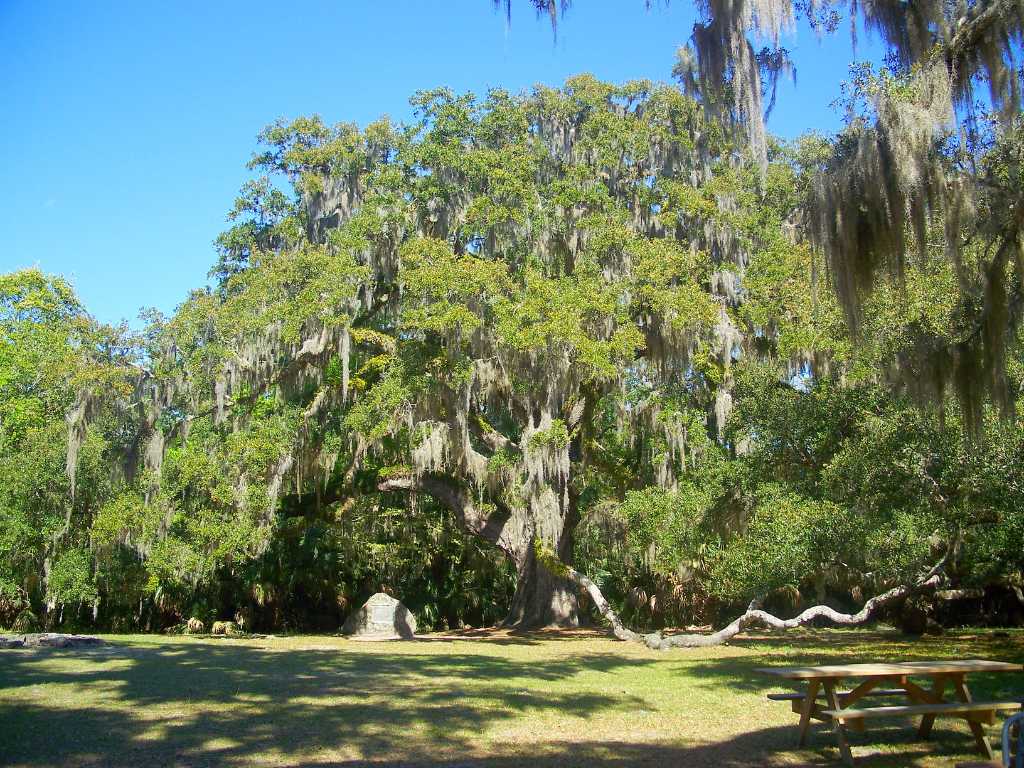
Lake Jackson Mounds State Park protects and conserves several earthen temple mounds which were part of a larger ceremonial complex known now as the Southeastern Ceremonial Complex. Two of the mounds are available for the public to view. Later, the site was part of a large estate owned by Colonel Robert Butler. The ruins of a grist mill can also be seen at the interpretive trail.
There are two trails at this state park. The Butler Mill Trail includes the mounds and the interpretive trail. It’s about a mile long. A nature trail near the entrance to the park is roughly another mile. The park’s website says the boardwalk is closed, and AllTrails says the Butler Mill Trail is closed. However, several reviews since summer 2024 still show the trails open.
4. Fort Site Trail at Fort Cooper State Park
- Location: Inverness (Central Florida)
- Historic Significance: site of Fort Cooper, a picket fortification from the Second Seminole War
- Trail Highlights: interpretive kiosks and a replica of the southwest corner of the fort
- Trail Details: 1.5 miles
Fort Cooper was erected in the heart of what was Seminole country in the 1830s, a place called the Cove at Withlacoochee. After the US reneged on the Treaty of Moultrie, the Second Seminole War erupted. Major Mark Anthony Cooper built a fort to protect the sick and wounded who had been left behind by General Winfield Scott on his march to Fort Brooke in Tampa. The Seminoles laid siege to the fort for 16 days until reinforcements arrived for the soldiers in the fort.
The fort was destroyed long ago, but through research, volunteers and park staff created a replica of the southwest corner of the fort. The interpretive kiosks serve to inform and educate about the soldiers who defended the fort and the Seminoles who fought for their right to live in peace.
5. Hontoon Island Trails at Hontoon Island State Park
- Location: Deland (North Florida)
- Historic Significance: Native American mound, pioneer homestead
- Trail Highlights: shell mounds, ancient oak trees, historic sites
- Trail Details: 3-8 miles, looped and with spurs to various points of interest
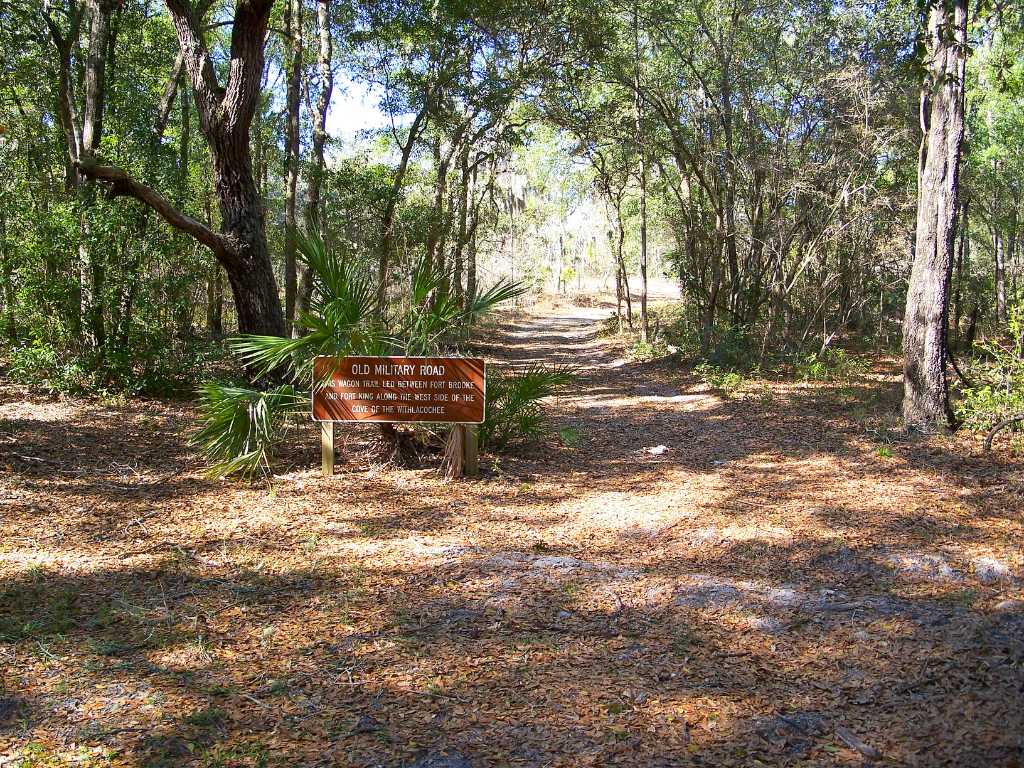
Bordered by the historic St. Johns River on one side and the Hontoon Dead River on the other, Hontoon Island is only accessible by boat or park ferry. If you decide to visit this river island, you’re in for a treat. Artifacts indicate indigenous people used the island for thousands of years, fishing in the river and gathering shellfish. A shell mound is visible from the short 3-mile trail.
After the Spanish arrived in Florida, the island served many purposes. Legend says one of Spain’s many missions may have existed here. Starting in the 1860s, the island was a homestead, a base for a commercial fishing operation, and a cattle ranch.
6. Letchworth-Love Interpretive Trail at Letchworth-Love Mounds Archaeological State Park
- Location: Tallahassee (North Florida)
- Historic Significance: tallest Native American ceremonial mound in Florida
- Trail Highlights: Ceremonial mound and smaller shell mounds
- Trail Details: ½-mile interpretive trail and ½-mile nature trail
The Letchworth-Love mounds were constructed between 1100 and 1800 years ago, probably by the Swift Creek Culture. Members of the Swift Creek are known for mound-building and intricate pottery patterns, which is characterized by complicated stamped designs involving mostly curvilinear elements. The designs were carved on wooden paddles then stamped on earthenware before firing it.
Letchworth-Love Mounds Archaeological State Park is only 188 acres. An interpretive boardwalk leads from the parking lot to the 51-foot tall mound. Other mounds are visible around the park, too. From the ceremonial mound, explore the Weeden Trail, another half mile trail which loops back to the parking lot.
7. Old Bellamy Road Trail at O’Leno State Park
- Location: High Springs (North Florida)
- Historic Significance: site of one of the oldest roads in Florida
- Trail Highlights: the first federally funded road in Florida
- Trail Details: 1 mile unpaved trail
O’Leno State Park is the site of a town which met the fate of many towns in Florida- the railroad bypassed it, and people moved away. From the 1870s to the turn of the century, Leno was a thriving town with two grist mills, a saw mill, six cotton gins, a general store, a hotel, a livery stable, and a doctor’s office. Located along the banks of the beautiful Santa Fe River, people still went there to swim and picnic on days off. They called it Old Leno which eventually became O’Leno.
The state park is one of Florida’s oldest. For a while it served as a training camp for Florida Forest Service. Today, it’s popular for hiking, camping, and kayaking. The Santa Fe River drops below ground in O’Leno State Park and surfaces again three miles downstream at River Rise State Park.
8. Paynes Creek Trails at Paynes Creek State Park
- Location: Bowling Green (south Central Florida)
- Historic Significance: 1840’s outpost and fort
- Trail Highlights: Fort Chokonikla site, Kennedy and Darling store site
- Trail Details: approximately 2 miles in several loops
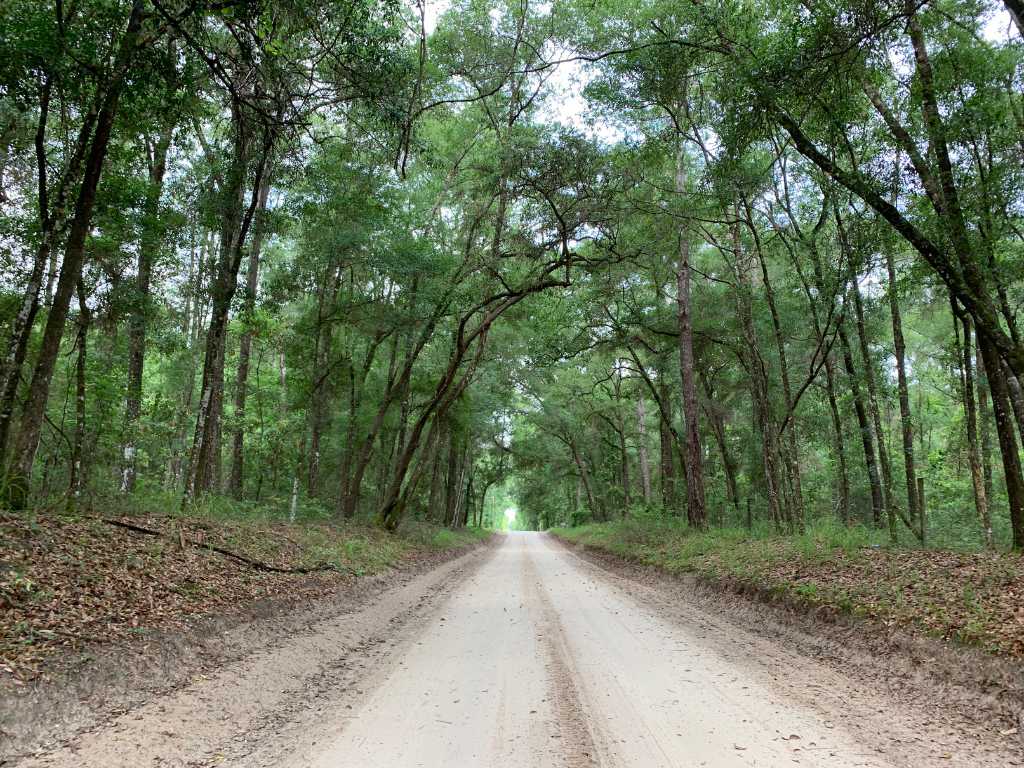
In 1849, among rising tensions between settlers and Seminole Indians, the Kennedy-Darlington Trading Post at the northern border of the Seminole reservation was attacked. Two workers died, and the attack prompted the US Army to build a chain of forts in Florida’s interior. Fort Chokonikla was the first of those forts, near the site of the Kennedy-Darlington Trading Post. Though it never came under attack, dozens of soldiers died from disease-carrying mosquitoes and the fort was abandoned within a year.
Nothing remains today of the fort or trading post. The Paynes Creek State Park Visitors Center, however, exhibits artifacts and several replicas which show how each looked and what life would have been like on Florida’s frontier.
The trail which begins at the Visitor Center passes first by the fort site then loops over to Paynes Creek where the trading post overlooked the creek. There is also a monument honoring the men who died in the trading post attack.
Elsewhere in the park, visitors can hike the roughly 1 mile loop trail along Payne Creek to the Peace River. The park also offers a playground, picnic shelters, and kayak/canoe launch.
9. River Trail at Koreshan State Park
- Location: Estero (southwest Florida)
- Historic Significance: begins in the historic settlement
- Trail Highlights: follows the river
- Trail Details: less than a half mile end to end
In 1880, Dr. Cyrus R. Teed founded a religious group in Moravia, New York. The group believed in communal living and that the universe existed inside the Earth. After more than a decade facing hostility and criticism, the group moved to the Florida frontier seeking a place where they could live in peace. They founded the Koreshan Unity Settlement on the banks of the Estero River in 1894.
Dr. Teed died in 1908, and by 1961 only four members remained. They gifted the settlement’s 305 acres to the state of Florida in honor of Dr. Teed. From that gift sprang Koreshan State Park. The Koreshan Unity Settlement Historic District is on the National Register of Historic Places and is the central attraction of the state park. It comprises several historic buildings and bamboo trails.
The River Trail begins at the historic settlement and follows along the river’s edge, ending at the playground and boat ramp near the campground. At less than a half mile, it’s an easy walk with beautiful views in an historic and serene setting.
10. Springs Trail at Werner-Boyce Salt Springs State Park
- Location: Port Richey (central Gulf coast)
- Historic Significance: pre-Columbian indigenous quarry, salt works during the Civil War
- Trail Highlights: Several freshwater and salt springs
- Trail Details: More than 2 miles of trails passing through various ecosystems and past springs with a tidal waterfall at the end of the trail
Excavations at Werner-Boyce Salt Springs State Park show that the Tocobaga tribe quarried limestone in this area for their tools. No permanent villages have been found in the park though a Native American mound on the south side of the nearby Pithlachascotee River indicates a village was located at or near that site.
In the 1800s, cattle ranchers discovered the salt springs when they noticed their cattle licking the salt off rocks near those springs. A salt works was established there and used through the Civil War. Later, during World War II, the marshlands of the area were used in bombing practice, creating some of the lakes found in the park today.
Visitors to the park can hike several loops which add up to more than four miles of trails. At the end of the Spring Trail, a tidal waterfall appears at very low tide, and there is an exhibit with artifacts from the salt works. In the park, there is also a butterfly garden and a kayak launch with waterways throughout the park for kayaking.

Tips for Enjoying Historic Trails
Enjoying historic hiking trails in Florida state park is not very different from enjoying any other hiking trails. Basic trail etiquette and tips apply:
- Wear sturdy shoes, a hat, and sunscreen
- Carry water in a reusable bottle
- Stay on designated trails and avoid disturbing ruins or artifacts
- Practice Leave No Trace principles
- Many historic state parks offer guided tours or re-enactments, enhancing your time at these parks
Conclusion
For history lovers who love hiking or nature trails, there are few better ways to enjoy historic sites than on historic hiking trails.Whether short or long, these trails add to the hiking and state park experience, taking visitors deeper into Florida’s past. Next time you’re in Florida, take a few hours to enjoy the historic hiking trails in state parks near you.
Let’s Connect!
Follow me on Facebook, YouTube, and Instagram. And if you’re looking for a great community for sharing travel tips, discounts, secret spots, and hidden gems, go join my Facebook group, Florida Travel Tips & Secret Spots.
Travel Resources:
These are the places I first go when planning or booking travel. They ARE affiliate links so if you use one I may earn a small commission (at no cost to you) and (bonus!) it’ll help me keep running this site. Visit my travel resources page to see all of the services and gear I recommend.
Flights: We always check flight prices and information on Way Away first.
Hotels: We use Expedia to compare and book hotels. We also love Booking.com for boutique hotels and B&Bs.
Vacation Rentals: For vacation rentals and other non-traditional lodging options, VRBO is our go-to.
Tours & Tickets: We use Viator for private tours and unique experiences.
Rental Cars: Though we prefer to experience a city through its public transportation, there are times when a rental car is needed and in those instances, we use Discover Cars.
Travel Insurance: No one wants to need it, but it’s great to have when you do. VisitorsCoverage is our go-to provider.


