
Reasons Tampa Loves the Ever Popular Gasparilla Pirate Festival


The Gasparilla Pirate Festival parade begins the last Saturday of January with the invasion of the Jose Gasparilla. (TBO)
Yesterday, Tampa residents and visitors turned into pirates. We invaded Tampa and overran the streets, dressed in traditional pirate garb (or something resembling pirate gear), armed with treasure. We aarghed(!) and drank rum. We threw treasure at people and in some cases stole it from the unsuspecting. The invasion of the Jose Gasparilla overtook first the waters of Tampa Bay and Davis Channel and then the streets of downtown Tampa. Yesterday, Tampa celebrated the Gasparilla Pirate Festival.

The Gasparilla Pirate Festivals takes place over approximately five weeks. Events include the Gasparilla Childrens Parade – an alcohol-free parade geared just to children, Gasparilla Pirate Parade held the next weekend, the Gasparilla Music Festival, Gasparilla Distance Classic, Gasparilla Festival of the Arts, Sant’Yago Knight Parade (think raunchy Mardi Gras type…definitely NOT for kids or those easily offended, though organizers are trying to change that reputation), Gasparilla Film Festival, and the Gasparilla Outbound Voyage which marks the end of the festivities. This year, the events run from January 20th to March 3rd.
Yeah, we like a good, long party in Florida.
Twice Gasparilla has run with the Super Bowl held in Tampa, the last time drawing the biggest crowds of the parade at an estimated 750,000. Every year, Gasparilla runs through Mardi Gras, not a surprise as the parade was originally modeled after that event. Beads are still a huge part of the festivities. A few times Gasparilla has been cancelled – twice due to the World Wars and once because of disagreements between the Mystic Krewes that organize it and city officials. Still, Gasparilla has become synonymous with Tampa and with huge amounts of fun.

History of Gasparilla Pirate Festival
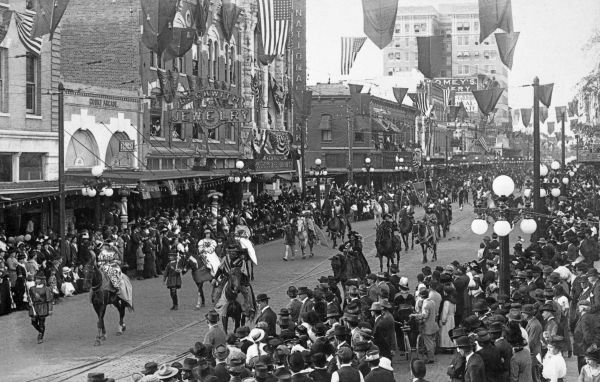
In 1904, the Tampa Tribune‘s society editor and Tampa’s director of customs wanted to spice up the relatively sedate May Day celebration so they created the Gasparilla Carnival, a combination of Mardi Gras traditions and the legend of Jose Gaspar. The first invasion took place by horseback. The second year, every automobile in Tampa participated in the parade. The first invasion by water of a pirate ship happened in 1911.
The legend of Gasparilla started four years earlier than Tampa’s first Gasparilla Carnival. In 1900, as part of a marketing campaign, Henry Plant’s railroad and Boca Grande Hotel published a brochure with the fanciful story of Jose Gaspar, “the last of the buccaneers”. The Tampa officials expanded on the story for their spring festivities. Then, in 1940, the Florida Department of Education commissioned a short history of Jose Gaspar to be used in schools. Ironically, several books about Florida history and piracy in the Caribbean erroneously tell the story of Gaspar as if the pirate actually lived.
The Legend of Jose Gaspar, aka, Gasparilla
Born around 1756 in Barcelona, Spain, Jose Gaspar may have been a navy officer or a nobleman and advisor to King Charles of Spain. Either way, he turned to piracy rather early in his career and plundered more than 40 ships in the nearly 40 years he is said to have operated along the Gulf coast of Florida.
According to legend (the one written by Florida), Gaspar created his base of operations on Gasparilla Island in Charlotte Harbor. The similarity of the island’s name to his own drew him to its shores where he and his crew built huts made from palmetto logs and thatched roofs. Gaspar also changed his name to Gasparilla and changed the name of his flagship from Florida Blanca to Gasparilla (something no serious pirate would do as it’s considered bad luck to change a boat’s name). Strangely, there is no mention in any of the Gaspar legends that Gasparilla ever landed in the Tampa Bay area.
Gaspar is said to have been a well-mannered pirate. Like many other pirate captains, he gave his prisoners a chance to join his crew or to be killed if they refused. He captured many women prisoners though his diary and other documents show that he treated them fairly and with respect. He married one of his captives and encouraged his men to do so as well. Gaspar’s reign came to an end in 1821 when he encountered the USS Enterprise and, rather than being captured and imprisoned, wrapped an anchor chain around his waist and jumped into the waters of the Gulf of Mexico. I should note here that no records exist either in the United States or in Spain of any man – pirate, captain, nobleman, advisor, or naval officer – by the name Jose Gaspar.

Modern Day Gasparilla Pirate Festival
More than 300,000 pirate-people attend the main parade every year. Some years, as noted above, draw an even bigger crowd. The parade once runs 4 miles, all of it lined several deep with parade goers eager to catch the beads thrown from parade floats. Hawkers sell pirate hats, plastic horns, and other trinkets while food trucks line the streets closest to the parade to sell their food and drink to parade goers. Those who aren’t interested in braving the crowds along the parade route gather in local bars, many open as early as 9 AM, and watch the festivities on TV. Other places, particularly restaurants, hold special ticketed events, much like you see on New Year’s Eve.
If you want to go one year, note that the Gasparilla Pirate Festival parade is held the last Saturday in January. The children’s parade occurs the weekend before while the night parade happens about two weeks after the main daytime parade. Other events happen throughout the 5-6 weeks of festivities and can be found on various websites. The main events are held every year. Smaller events occur sporadically, sometimes only once, sometimes year after year, and always taking advantage of Gasparilla fever.


Great read, really interesting to know. I had no idea this was a thing. LOVE IT