
Africans and Other Florida Slaves in the 1700s

In Part 1 of this series, Slavery in Florida in the 1600s, we learned how slavery started in Florida. In the 1700s, La Florida still remained under Spanish rule for most of the century. This meant that Florida slaves experienced much kinder treatment than their counterparts in the British colonies. Spain’s inclusive policy towards slaves also meant that many runaways from those British colonies sought sanctuary in the Florida territory. Additionally, free black men and women found a great deal of success in cities like St. Augustine.
First Spanish Period
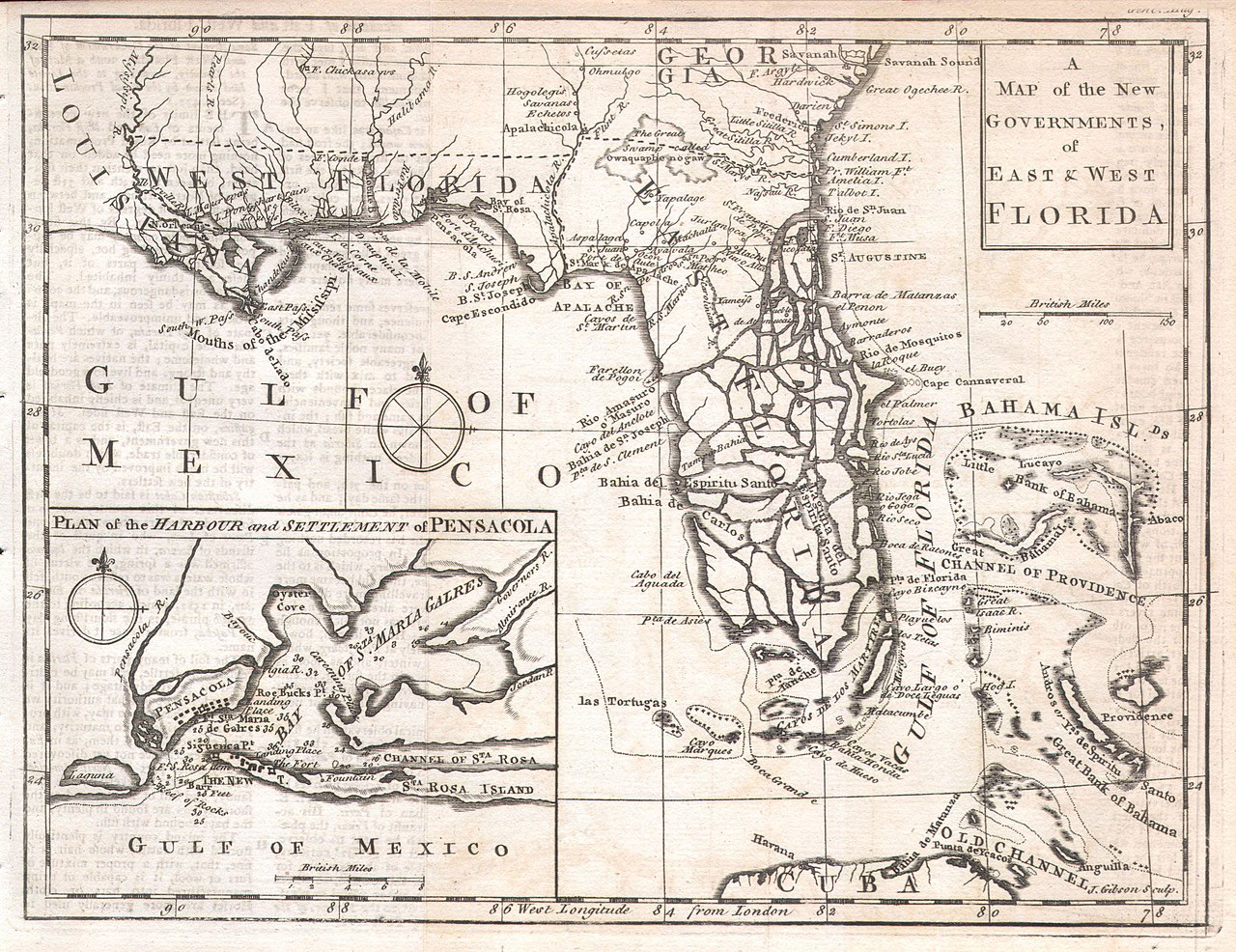
The First Spanish Period in Florida lasted until 1763 when Spain traded Florida to Great Britain in exchange for control of Havana, Cuba and Manila, Phillipines. Florida had always been a sort of afterthought for Spain. It didn’t have gold or other natural resources important to Spain so it acted more like a rest stop and buffer than anything else. Through the first couple of decades in the 18th century, the Florida territory gradually diminished in size as the British to the north and French to the west pushed the borders more and more inward.

Slavery in Spanish Florida
The slavery system in Spanish Florida was built upon a task system. Slaves were given tasks to complete for the day and once done, the rest of the day was theirs. Many slaves found the time, then, to grow their own crops and engage in other activities, such as trades and services, which netted them income. Additionally, the plantations developing in Florida in the 18th century were “diversified operations…sometimes employing black overseers.”1 Plantations devoted to cattle and timber, in particular, required a mostly autonomous workforce.
Attacks from Carolina
In the early 1700s, the Yamassee joined British raiders from the Carolina territory in sieges on Spanish missions and St. Augustine. The raiders initially took other Indians to be sold into the slave trade in the British colonies; however, as those human resources ran low, the Yamassee began to capture black slaves as well. This kidnapping of Spanish Florida’s black slaves ended in 1715 when the Yamassee engaged in a two-year war with the British.
Original Sanctuary City
King Charles II’s royal edict of 1693 to his Governor in Florida:
“…As a prize for having adopted the Catholic doctrine and become Catholicized, as soon as you gt this letter, set them all free and give them anything they need, and favor them as much as possible. I hope them to be an example, together with my generosity of what others should do.”
This information quickly spread among the enslaved in the British colonies and those who could escape, did so. One could say that St. Augustine was the original sanctuary city in what would become the United States.
Fort Mose
As more fugitives arrived in Florida, the Governor established a settlement for the free black men. Located approximately two miles north of St. Augustine, it was called Gracia Real de Santa Teresa de Mose. Today we call it Fort Mose.
One of the requirements of becoming freed in St. Augustine was for the black men to join the Spanish military for four years. Those men became the free black militia, first created in 1683, and were an important first line of defense for the city of St. Augustine when they moved to Fort Mose. It is widely considered the first legally sanctioned community of freedmen.

Francisco Menendez
Francisco Menendez, captured on the Gambia coast and sold into slavery in South Caroline, is recognized as one of the best soldiers for the Spanish crown in the Americas. He escaped from South Caroline in the 1720s and earned his freedom defending St. Augustine from the British in 1727. When Fort Mose was established in 1738, he was granted unconditional freedome and became the leader of the Black militia there as well as the leader of the entire community. From this base, Menendez led several raids on the British. He would go on to raid English ships and establish the settlement of San Agustín de la Nueva Florida in Cuba.
British Florida
In 1763, with the Treaty of Paris, Spain ceded all of Florida to Britain while France ceded the territory of Louisiana to Britain. The British split their new territory into East Florida (to the Apalachicola River) whose capitol was St. Augustine, and West Florida whose capitol was Pensacola. In exchanged, Spain regained control of Havana, Cuba and Manila, Phillipines.
During the transition to British control, the Spanish colonists, slaves, freed blacks, and allied Indians fled to Cuba. In an effort to recolonize East Florida, the British offered land grants to settlers who would move to Florida and help defend it. British colonists migrated to the territory with their enslaved Africans and established numerous plantations. However, they also brought their own slave code.
Slave Code
British Floridians brought their slave code with them from South Carolina. Under the British, blacks barely had a hope for gaining their freedom. Large numbers of African slaves were imported to work the Florida plantations. The British regarded slaves as “barbarous, wild, savage natures, and such as renders them wholly unqualified to be governed by the laws, customs, and practices of this Province.”2 The slave code included the following:
- Slaves were forbidden to leave the owner’s property unless they were accompanied by a white person or had permission. If a slave leaves the owner’s property without permission, “every white person” is required to chastise such slaves.
- Any slave attempting to run away and leave the colony (later the state) receives the death penalty.
- Any slave who evades capture for 20 days or more is to be publicly whipped for the first offense, branded with the letter R on the right cheek for the second offense, and lose one ear if absent for 30 days for the third offense, and castrated for the fourth offense.
- Owners refusing to abide by the slave code are fined and forfeit ownership of their slaves.
- Slave homes are to be searched every two weeks for weapons or stolen goods. Punishment for violations escalates to include loss of ear, branding, and nose-slitting, and, for the fourth offense, death.
- No slave is allowed to work for pay; plant corn, peas or rice; keep hogs, cattle, or horses; own or operate a boat; buy or sell; or to wear clothes finer than ‘Negro cloth.’
- No slave is to be taught to write, to work on Sunday, or to work more than 15 hours per day in summer, and 14 hours in winter.
- Willful killing of a slave exacts a fine of £700, “passion”-killing £350.
- The fine for concealing runaway slaves is $1,000 and a prison sentence of up to one year.
- A fine of $100 and six months in prison are imposed for employing any black or slave as a clerk.
- A fine of $100 and six months in prison are imposed on anyone selling or giving alcoholic beverages to slaves.
- A fine of $100 and six months in prison are imposed for teaching a slave to read and write, and death is the penalty for circulating incendiary literature.
- Freeing a slave is forbidden, except by deed.

The American Revolution saw an increased influx of British colonists move into Florida, bringing their Black slaves with them. After Patriots took control of Charleston and Savannah, Florida became the last British haven in North America. During this time, a few Black men earned their freedom by performing military acts for King George III. This, however, was not the trend and was extremely rare.
Black Seminoles
Even under British rule, Florida remained lightly settled which meant African slaves still found it relatively easy to disappear into the wilderness. During the First Spanish Period, some runaway slaves preferred to remain free of any foreign government. These fugitives established their own settlements, often near Indian villages, and eventually an Afro-Indian creole culture developed. As Blacks and Native Americans mixed, they became known as Black Seminoles. During British rule, African slaves continued to escape to these villages. The trend continued when Britain ceded Florida back to Spain after the American Revolution. Many slaves took advantage of the chaos and escaped to nearby Indian villages.
Florida Slaves During Second Spanish Period
During the Second Spanish Period, Spain found it difficult to continue supporting and defending its many holdings. The value of exports accounted for only about 1/3 of the expenses incurred by the province. The boundaries of it’s newly regained territory were in dispute and much broader than their earlier Florida, and several other Spanish territories had mounted independence movements, taxing Spain’s resources further.
Notable Black Families
Both men and women enjoyed freedoms under Spanish law during the Second Spanish Period. For instance, freed African women “enjoyed full citizenship and the legal and customary rights enjoyed by Spanish women. They managed plantations, operated small businesses, litigated in the courts, and bought and sold property, including slaves. Free black women also went to court, if necessary, to protect their financial interests.”3 Some also married prominent white men and managed their plantations.
Free black men worked as jewelers, cartwrights, butchers, tanners, shoemakers, carpenters, and innkeepers. They worked on government projects and took advantage of the economic opportunities available in St. Augustine.
With a rollback of the slave code and reintroduction of Spanish slave policy, in particular their ability to self-purchase, a number of Black families rose to a level of prominence and their descendants helped shape the future Florida after statehood.
Felipe and Filis Edimboro
Felipe and Filis Edimboro purchased their freedom from Florida’s wealthiest plantation owner, Don Francisco Sanchez. Felipe purchased his own freedom first, then that of his wife and children. They officially married in 1794, the same year they petitioned for their freedom. Felipe worked as a butcher, and together they threw parties in St. Augustine for the Black community, before and after their freedom. They became landowners, and Felipe served as sergeant of the Black militia.
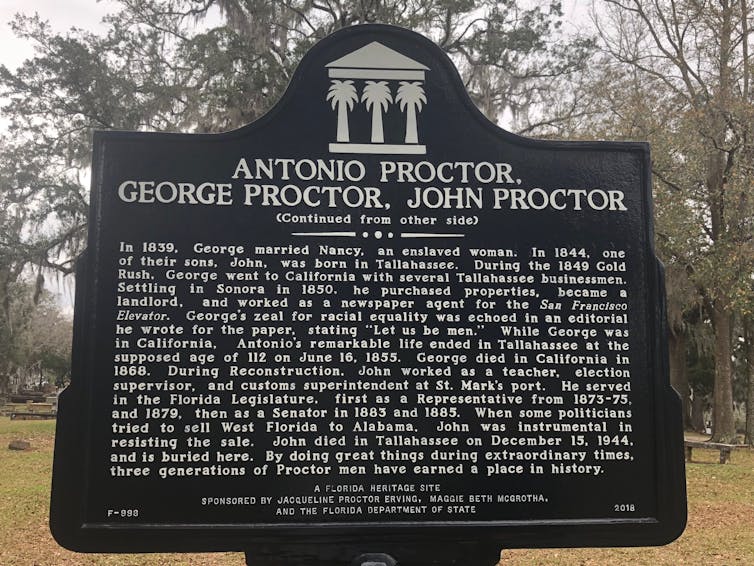
Eusebia Edimboro, one of Felipe and Filis’s daughters, had a child with Antonio Proctor. Antonio was an enslaved man and also considered one of the best Indian translators in Florida. Antonio and Eusebia worked on the Florida frontier, eventually earning Antonio his freedom. Their son George became a master carpenter and builder, and grandson John Proctor served in the Florida House of Representatives in the 1870s and in the Florida Senate from 1883 to 1886. A memorial plaque in Tallahassee ends with “By doing great things in extraordinary times, three generations of Proctor men have earned a place in history.”4
Georges Biassou
Georges Biassou was a Haitian who led the 1791 slave uprisings in Saint-Dominique. He pled allegiance to Spain when France declared war on Spain in 1793. He fought as a member of the Black Auxiliaries of Charles IV on Hispaniola and was granted his freedom. When Spain left Hispaniola, Biassou and the Black Auxiliaries sailed to St. Augustine where they were guests of Governor Quesada for two nights. Despite years fighting for freedom, Biassou went on to become a plantation owner, farmed by his own slaves. He was widely considered a hero and defended Florida against Seminole attacks until his death in 1801.

Prince Witten
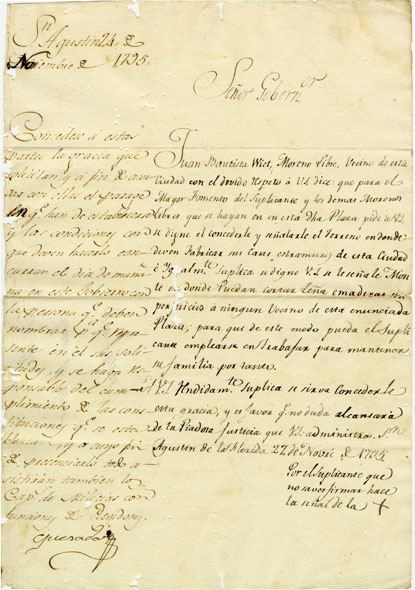
Prince Witten escaped from South Carolina in 1783 after several failed attempts. He and his wife, Judy, became prominent members of Black society in St. Augustine. Prince worked as a carpenter, even working on government projects around St. Augustine, and Judy worked as a laundress. By 1793, they lived in a prominent part of St. Augustine surrounded by white neighbors. Prince joined the Black Militia, became a lieutenant, and achieved hero status in the 1800s.
Spanish Policy Change in 1790
Increased pressure from the newly-formed United States caused Spain to change Florida’s sanctuary policy in 1790. Escaped slaves could no longer achieve freedom through religious sanctuary. However, they could still purchase or earn their freedom in Florida. They needed access to work opportunities and a cash economy, and while this was a difficult requisite for many slaves to achieve, the access to St. Augustine’s legal system enticed many to continue working to towards living in or near the city.
Final Thoughts on Florida Slaves in the 1700s
Enslaved people in Spanish Florida earned a number of freedoms through the 1700s. Many of those who achieved freedom became prominent members of St. Augustine society and their descendants would go on to achieve success in Florida after it became a US territory and state. However, with Spain’s increasing troubles and Florida’s secession to the United States, Florida slaves would experience a number of hardships in the 1800s.
References
- Colburn and Landers, The African American Heritage of Florida (Gainesville: Library Press @ UF, 2017) p. 20
- Phillips, Steve, Brown Is the New White (New York: The New Press, 2016) p. 49
- Landers, Jane, Black Society in Spanish Florida (Chicago: University of Illinois Press, 1999) p. 144
- Landers, Jane, “What Catholic Church records tell us about America’s earliest black history“, The Conversation (February 27, 2019)

This was such an interesting read for the history buff in me. OS much of this is never shared.
Yes, you’re right. It was so enlightening researching it and learning so much more than what we’re taught.
Thanks Cris, these posts have been massively educational, so well thought out. Thanks so much for sharing this information at a time such as this.
Thank you so much, Luke.
What a great history lesson you’ve compiled! A lot of great information.
I caught your first article in this series and they are so full of information. Growing up in Alabama, I did not learn about FL history so very interesting!
Florida sure was pretty progressive for their time. Learned a lot.
Wow. I’m learning so much. Thank you for researching this for us and sharing in a concise and easy to read format. So many things I didn’t know, unfortunately.
Thank you, Jenny. There’s so much about this part of our history that many of us don’t know. It’s up to all of us to make sure history isn’t forgotten or rewritten.